Why electric scooter battery fires are surging in Spain (and what European data already shows)
Three years ago, fires caused by e-scooter batteries were a rarity in European fire-service reports. Today they are a category with their own name. London Fire Brigade recorded 206 lithium-battery fires in 2025, an average of 17 a month. In the United States, the FDNY in New York documented 268 lithium-battery fires in 2023, with 150 people injured and 18 fatalities (most of them at home, asleep, while the battery was charging nearby), followed by 277 fires in 2024. In Germany, the Institut für Schadenverhütung summarised what all the cases had in common: three out of four battery fires happen during charging.
Spain is running two to three years behind that curve. But neither the size of its fleet, nor its 24/7 delivery services, nor the current regulatory framework keeps it out of the trend. This guide lays out what European data already shows, what structurally puts Spain on the same trajectory, and which concrete measures genuinely reduce the risk for the user, without waiting for Spanish fire services to publish their own consolidated figures.
What European and US data already shows
The most recent official figures, country by country:
- London Fire Brigade (UK): 206 lithium-battery fires in 2025, an average of 17 a month. UK-wide, lithium-ion battery fires grew by 93% between 2022 and 2024, and aggregated figures for e-bikes reached 362 incidents in 2024.
- OPSS (UK): 211 reported fires involving e-bikes and e-scooters in 2024, 39 of them e-scooters specifically. Since 2020, 10 deaths and 190 injuries have been linked to fires of this kind.
- FDNY (New York City): 268 lithium-battery fires in 2023, with 150 people injured and 18 fatalities, followed by 277 fires in 2024. The majority of victims were at home, asleep, while the battery was charging in an adjacent room.
- CPSC (United States): 19 deaths from micromobility fires between 2017 and 2022. Between January 2023 and May 2024 there were also 156 fire reports linked to the use of non-original or universal chargers.
- Institut für Schadenverhütung (Germany): three out of four battery fires happen during charging. Not while riding, not in storage, specifically when the battery is plugged in.
- Fire and Rescue NSW (Australia): 165 lithium-battery fires in 2022, 272 in 2023 and 323 in 2024. The service has issued formal alerts asking that e-bikes and e-scooters be stored and charged away from the evacuation route, and New South Wales introduced mandatory safety rules for electric micromobility devices in February 2025, the first of their kind in the country.
- Canada: the fire services of Toronto, Vancouver and Montreal have issued advisories on lithium-battery fires in residential buildings, and several provinces are reviewing their building codes to regulate indoor charging and storage of personal electric vehicles.
What matters about these numbers isn't the absolute magnitude (it remains a small percentage compared with the total vehicle fleet), but the rate of growth and the pattern. Growth is accelerating. The pattern doesn't change: same time of day (overnight charging), same type of failure (cell in thermal runaway), and, above all, the same contributing factors across post-incident reports.
Spain: two or three years behind, not immune
Spain's mass adoption of e-scooters happened between 2019 and 2022, two or three years after the UK and the US. The incident curve that those countries started to see in 2021-2022 is the one beginning to surface in Spain now.
Three structural realities are worth being clear about:
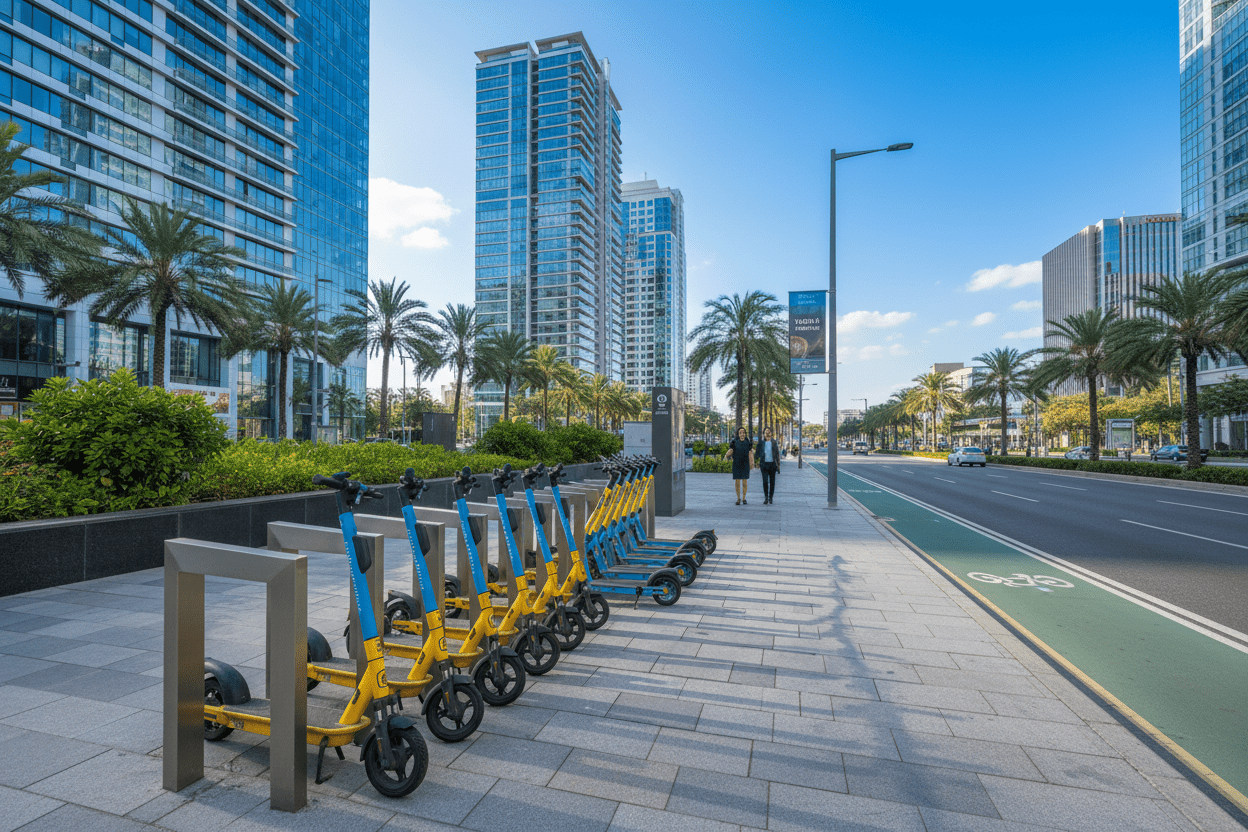
- Madrid and Barcelona are in the European top tier for individual and shared e-scooter penetration. Whatever is happening with batteries in other major European cities is happening here with the same intensity.
- Delivery services run massive fleets: Glovo, Uber Eats, Bolt Food, Just Eat. Tens of thousands of scooters operate twelve or fourteen hours a day and charge overnight, often in shared flats, communal garages or storage rooms with no supervision.
- Cases already appear in mainstream press: Madrid, Barcelona, Valencia and Zaragoza have recorded, over the past two years, documented incidents of fires in homes or storage rooms attributed to e-scooter or e-bike batteries.
What Spain still lacks, but the UK and US have, is a consolidated, separately reported register of "fires caused by lithium batteries in electric mobility". Spanish fire services log them within "residential fires" or "electrical fires", which makes it harder to see the curve with the clarity available in London or New York. That lack of public visibility doesn't mean the phenomenon is small. It means the signal is mixed with the noise.
Why the curve is structurally inevitable in Spain
Four factors put Spain on the same trajectory (with a delay, but with the same intensity) as London and New York:
1. Large and young fleet
Most of Spain's e-scooter fleet dates from 2020-2024. Lithium-ion batteries start to degrade noticeably after 500-800 charge cycles, typically three to five years of heavy use. Spain's fleet is now entering the window where the risk of cell failure rises significantly. What was a "new and safe" fleet in 2022 is a "starting to age" fleet in 2026.
2. No specific battery certification requirement
In New York, since 2023, Local Law 39 prohibits the sale of e-bikes and e-scooters whose batteries aren't certified to UL 2272 or UL 2849. It's the regulatory answer to the pattern fire services had been documenting for years: non-certified batteries of inconsistent quality cause the majority of incidents.
In Spain, Royal Decree 970/2020 (DGT), in force since January 2021, regulates personal mobility vehicles (VMP) in terms of vehicle homologation (power, speed, dimensions, wheels), but does not require specific certification of the battery as a component. A scooter can be legal to ride in Spain and, at the same time, carry a battery that wouldn't legally sell in New York.
3. Non-original chargers and informal repairs
The pattern that appears in more than 80% of London Fire Brigade post-incident reports is the use of a non-original charger. Spain, with a very open purchase channel via Amazon, AliExpress and small direct importers, is fully exposed. Buying a "compatible" charger for €15 when the original costs €50 is exactly the decision that precedes a very high percentage of documented incidents.
4. Delivery riders charging in small flats overnight
Delivery services have created a very specific charging pattern: long daytime shifts, full battery discharge, return to the flat (often shared, often in dense residential neighbourhoods), plug into any available socket and sleep. The rider's flat is precisely the scenario that most concerns the FDNY in New York: multiple batteries charging simultaneously, zero supervision, limited ventilation, and neighbours immediately above and below. In Madrid, Barcelona or Valencia, this pattern repeats every night in thousands of flats.
The four patterns that recur in European reports
Cross-referencing the public post-incident reports of London Fire Brigade, FDNY, Greater Manchester Fire & Rescue, NSW Fire & Rescue and the German IFS yields four factors that appear in more than 80% of investigated cases. These aren't hypotheses. They are what repeatedly shows up in inspections.
- Non-original or "compatible" charger. Correct voltage on the label, but current curve and safety cut-off not calibrated for that specific battery.
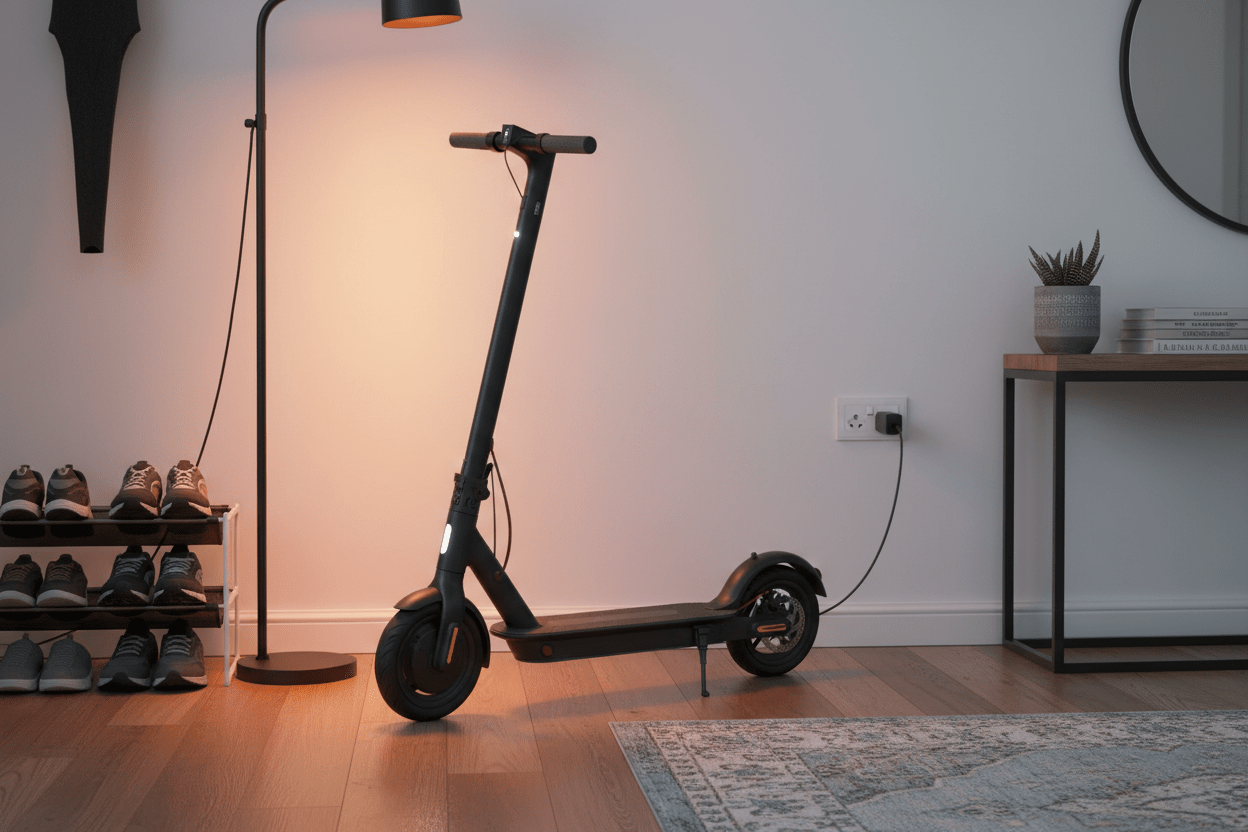
- Unsupervised charging, especially overnight. The reaction window shrinks from minutes to zero.
- Combustible material under or near the scooter (carpet, sofa, bed, curtains, clothes). At the moment of failure, they act as accelerants.
- No working smoke detector in the room. Or there is one but the battery is dead and it doesn't alert.
These four patterns are universal. There's nothing British, American or German about them. They appear in Spain in the few cases already publicly investigated, and they'll appear more frequently as registers are consolidated.
What's changing in Europe (and is coming to Spain)
The European regulatory framework is moving, although slower than the incident curve:
- Regulation (EU) 2023/1542 on batteries and waste batteries (the so-called Battery Passport): in force since August 2023, with progressive obligations through 2027 and 2030. Covers traceability, safety labelling and carbon footprint. For light-mobility batteries, safety and origin information will be mandatory.
- Standard EN IEC 62619: a safety standard for secondary lithium-ion batteries in industrial applications, including mobility. Already applicable and followed by serious manufacturers; the catch is that it isn't mandatory for end-consumer sale.
- EN 14604: European standard for residential smoke detectors. Required for over a decade, but still not installed in every Spanish home.
- Review of the DGT VMP framework: the DGT has announced, in recent months, a review of the regulatory framework for e-scooters that is likely to incorporate battery certification requirements. When it enters into force, and at what level of stringency, remains the open question.
In the meantime, the Spanish user is left in a grey zone: current regulation does not prevent the sale of a scooter with a questionable-quality battery. The responsibility for protecting the home falls entirely on whoever uses it.
FROM THE DATA TO THE MEASURE
The data agrees on one thing: it almost always happens while charging
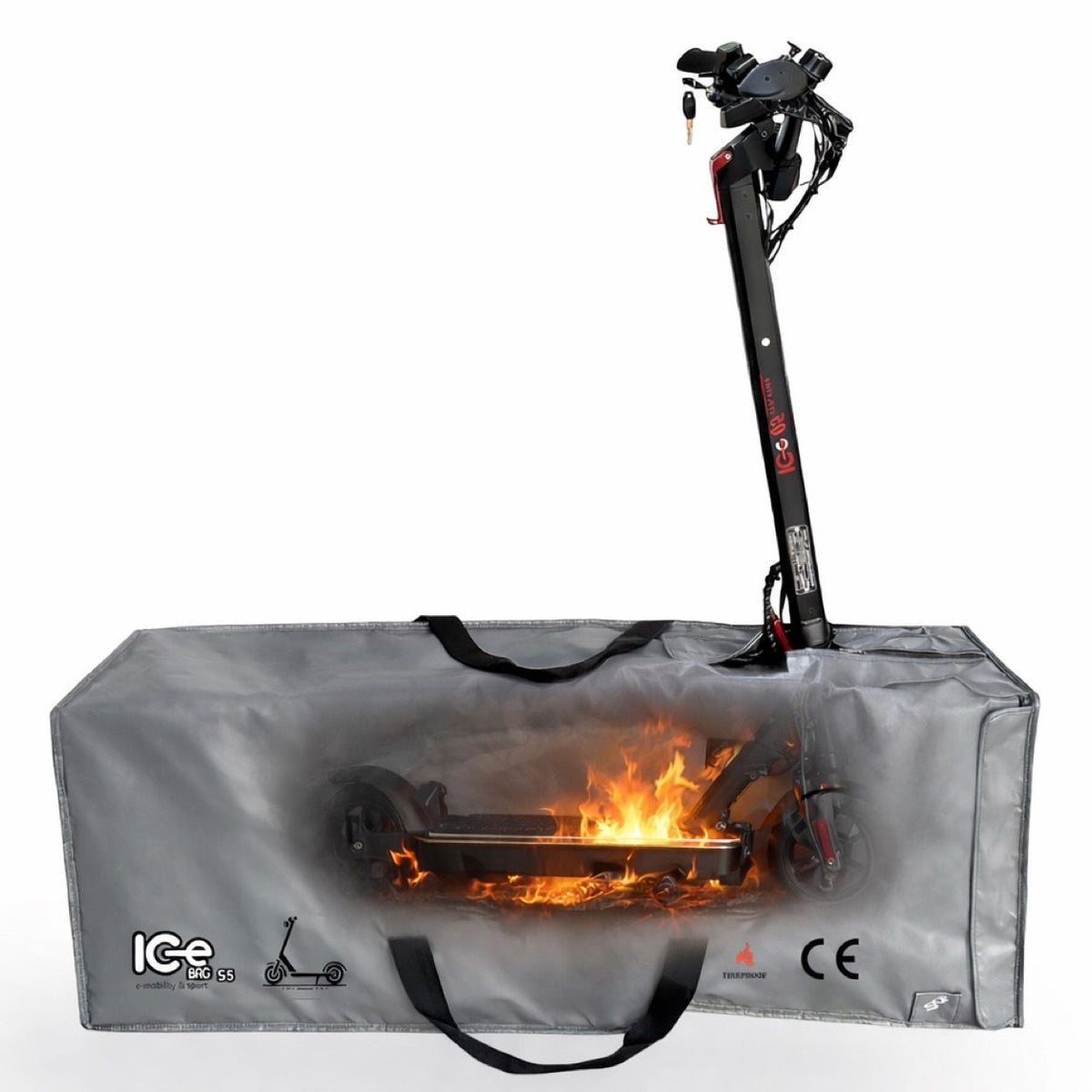
If the pattern repeats in every country, so can the measure. The ICe BAG confines the fire where it starts: it was tested in an independent laboratory by triggering a real thermal runaway on a complete scooter, battery included, inside the closed bag. Result: no flame escaping to the outside, no rupture of the enclosure and low smoke emission. Report ATS Electronic Technology, ATSR240420811.
What you can do today if you own an electric scooter in Spain
Five concrete measures that reduce the risk, ranked by how much impact they have, based on the consistent patterns documented by European fire services:
1. Check your charger
If it isn't the manufacturer's original, replace it. If yours broke and you've been using a "compatible" charger from a marketplace, stop. Buying the original directly from the manufacturer, even at €40-60, is the single measure that statistically moves the risk needle the most.
2. Supervised charging whenever possible
Charge while you're at home and awake. If your routine forces you to charge overnight, restrict it to the strict five hours the battery needs. A smart plug with a timer costs ten euros and reduces the exposure window. Not a complete solution, but strictly better than plugging in and forgetting.
3. Off the evacuation route
Not in the exit hallway, not in front of the front door. Ideally, in a room you can close with a door. A utility room, a laundry room or a covered balcony are much better than the hallway.
4. Smoke detector near the charging point
Compliant with EN 14604, ceiling-mounted, within three metres of the socket. Test it once a month with the test button. If your home has a single detector in the hallway, it isn't enough: smoke from a battery fire can take an extra minute to reach another room, and that minute matters.
5. Mechanical containment when charging inside the flat
If you're going to charge inside the home (the default for most users), a fireproof containment bag is the difference between a contained incident and a house fire. The bag doesn't prevent the battery from failing: it prevents the failure from becoming a different kind of problem. In the typical scenario, what escapes the bag is controlled smoke, not flames, and that smoke triggers the EN 14604 detector, which is exactly what it's designed for.
The honest bottom line for Spain
The risk, in absolute statistical terms, is still low per scooter and per home. But three factors give Spain's situation a specific profile worth recognising: large fleet entering battery-degradation years, no mandatory battery certification, and delivery services creating concentrated risk pockets in dense flats.
What happened in London between 2021 and 2024 (the shift from "occasional" to 362 annual incidents) is what we'll see in Spain between 2025 and 2028, absent early regulatory intervention. The good news: the individual measures that reduce risk are cheap, well-known and effective. The difference between someone who has a scare and someone who has a tragedy is rarely luck. It's almost always whether the four or five basic measures were in place.
Frequently asked questions
Does my home insurance cover a fire caused by an e-scooter battery? In principle yes, barring gross negligence. But it's worth checking in writing with your insurer: some apply exclusions or reductions if unsupervised charging, a non-original charger or a known-damaged battery is determined. We have a dedicated guide on this topic, linked at the end.
Is it safe to charge in the communal garage? It depends. The basic conditions are: your own power supply (not common-area electricity), compliance with local garage regulations, no combustible materials nearby, and, importantly, a minimum consensus with the building owners' association that battery charging is permitted there. Without those four conditions, it's better to charge elsewhere.
Are well-known brands (Xiaomi, Segway, Niu, etc.) safer? Statistically yes, on average. Large brands integrate cell quality controls and BMS (Battery Management System) systems that detect abnormal conditions and cut charging. But a non-original charger neutralises much of that protection. The important difference isn't only the vehicle brand, it's the coherence of vehicle + battery + original charger together.
What is the DGT doing about it? The current framework (RD 970/2020) regulates the vehicle, not the battery as a component. The DGT has announced a review of the framework that is likely to incorporate battery certification requirements, aligned with EU Regulation 2023/1542. The exact timeline isn't fixed.
Is Spain particularly vulnerable compared with other European countries? Not more than France, Italy or Germany in absolute terms. What is specific to Spain is the combination of large fleet + strong delivery presence + a very open import channel for small brands. That combination is less present in Germany (newer fleet, stricter eKFV regulation) or in France (earlier municipal regulation in Paris).
Related resources on our blog
- Is it safe to charge an electric scooter overnight? What firefighters actually say
- Fire safety solutions for electric scooters at home: a complete guide
- Does my home insurance cover an e-scooter battery fire?
- Where is the safest place to store your electric scooter at home?
Note: proven safety for e-scooter batteries
ICe BAG develops and produces fireproof containment bags and garages for the lithium-ion batteries of e-scooters and e-bikes. Specifically designed for residential use in flats, apartment buildings and storage rooms.

Written by Oscar Creix