Is it safe to charge an electric scooter overnight? What firefighters actually say
Almost everyone plugs in their e-scooter at night, goes to bed and forgets about it. It's convenient. But fire services in the UK, US, Germany and Australia have been asking for exactly the opposite for years. Why? And, more importantly: if you're going to do it anyway, how do you do it as safely as possible?
This guide isn't the usual "don't charge overnight". It's the honest, data-backed version: why the overnight window is statistically the worst, the patterns firefighters identify again and again in post-incident reports, and what combination of habits and equipment turns a serious risk into a manageable one.
Why overnight charging is the highest-risk window
Three numbers from the last year, all from official sources:
- London Fire Brigade: 143 incidents involving e-bikes or e-scooters in 2023, up 78% on 2022. The vast majority occurred during charging.
- FDNY (New York City): 268 lithium-battery fires in 2023, with 18 fatalities. Most of those who died were at home, asleep, with the battery charging nearby.
- Institut für Schadenverhütung (Germany): three out of four battery fires happen during charging. Not while riding, not in static storage, specifically when the battery is plugged in.
The common factor isn't charging time itself, it's context. The overnight window concentrates three things that the daytime window doesn't have all at once:
- No one awake to notice early warning signs. An unusual smell, a faint pop, abnormal heat, a swelling charger. During the day, someone's in the house and can react in the first minutes. At night, those minutes are lost.
- Longer total charging window. Most people plug in and sleep for seven to nine hours. Even if the battery is full in four or five, it stays plugged in, slowly accumulating micro-stress on cells that finished charging hours earlier.
- Deep sleep delays reaction. A smoke alarm will wake you, yes, but the first few seconds of disorientation are the most critical. If the fire is already fully developed by the time you orient yourself and reach the stairs, the difference between evacuating in time and not is measured in seconds.
What firefighters keep repeating
Read the public post-incident reports from London Fire Brigade, FDNY, Greater Manchester Fire & Rescue, NSW Fire & Rescue (Australia) and the German IFS, and four patterns appear in more than 80% of investigated cases.
1. Non-original or "compatible" charger
The most common factor. A generic, unknown-brand charger might show the right voltage on the label, but the current curve and safety cut-off aren't calibrated for your specific battery. Push an extra amp through it for three hours and a weak cell eventually gives way. This is the factor that shows up in at least eight out of ten London Fire Brigade post-incident reports.
2. Blocking the only escape route
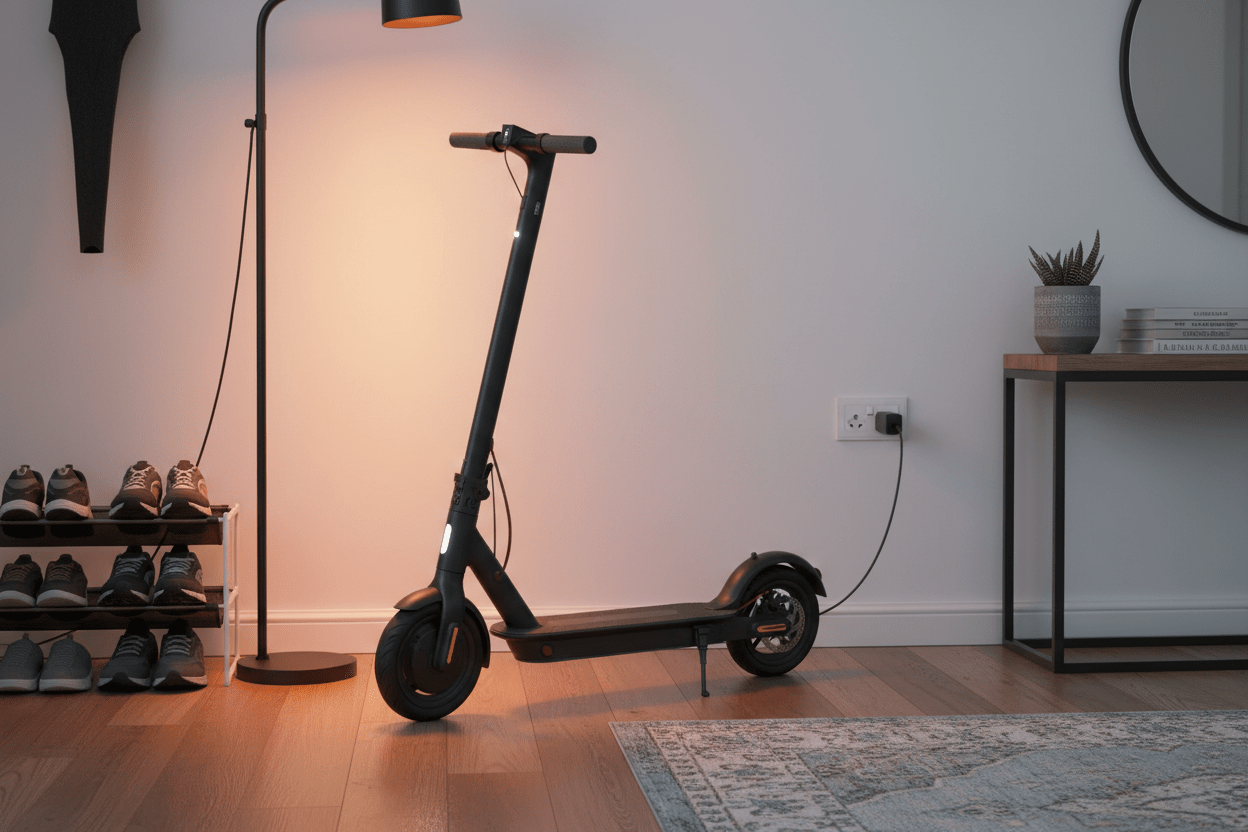
Scooter plugged in in the hallway, or near the front door. If it catches fire there, your exit is gone. Fire services worldwide have repeated this for years, and yet it remains the most common charging spot.
3. Combustible surface under the scooter
Carpet, sofa, bed, curtains within a metre. In a normal room this doesn't feel like a problem. At the moment of failure, those materials are accelerants: heat radiating downward ignites soft fibres and multiplies the rate of fire spread. A scooter on tile or concrete, a metre away from any upholstery, is a fundamentally different scenario from a scooter on the living-room rug.
4. No smoke detector in the charging room
This is the thin line between contained incident and tragedy. A smoke alarm compliant with EN 14604, ceiling-mounted within three metres of the charging point, gives you a one-to-three-minute window between first smoke and a fully developed fire. Those minutes are what you need to evacuate.
The four rules that reduce overnight risk (and why they work)
If you're going to charge overnight, these are the four non-negotiable rules:
Rule 1: Original charger only
If your original charger fails, replace it through the manufacturer. A "compatible" charger from a marketplace listing at a third of the price can wreck your battery in a single charge cycle. The saving isn't worth it.
Rule 2: Non-combustible surface, away from soft furnishings
Tile, concrete, stone, or a metal sheet if that's all you have. At least one metre of clearance from sofas, beds, curtains or any textile. The reason is physical: when a battery goes into thermal runaway, flames vent downward and sideways. Whatever is touching or very close to the scooter ignites.
Rule 3: Off the evacuation route
Not in the exit hallway, not in front of the front door, not blocking the kitchen if the kitchen is your only access to the landing. Ideally in a room you can close with a door (a utility room, a laundry room, a covered balcony).
Rule 4: Smoke detector in the same room
Within three metres of the charging point, on the ceiling or high on a wall. Compliant with EN 14604. Test it once a month with the test button. If your scooter has a removable battery: take it out, bring it inside, charge it in a fireproof bag, and the smoke detector covers the rest. This is the configuration the German IFS reports refer to when they talk about "residential charging with acceptable risk".
Detection + containment: the combination that actually works
A smoke detector alone only warns you once the fire is already developed. A fireproof bag alone contains the fire but doesn't warn you of anything. The combination is what genuinely changes the calculation.
Here's how it works: the battery fails inside the bag. The bag contains the flames, the heat (over 1,000°C within seconds) and the toxic gases. The only thing that escapes the bag, at low pressure and in a controlled way, is smoke. That smoke triggers the detector. You wake up to the alert with the room not yet contaminated, the flames not yet spreading, and the two to three minutes you need to evacuate and call the fire service.
This is precisely the scenario the combined system is designed for. It's not theory: independent tests published by manufacturers and European laboratories show containment for five to seven minutes at temperatures above 1,000°C. A standard smoke detector reacts to smoke in under thirty seconds. The maths is favourable.
CHARGING WITH A CONTAINMENT LAYER
Charging inside the bag, with the cable through
Every ICe BAG, from S1 to S5, has a cable pass-through, so you can charge with the bag closed. It is the containment layer that sits alongside your smoke detector: if a cell fails, the flames and the debris stay inside and you get time. Tested in an independent laboratory against a real thermal runaway, with a complete scooter inside the closed bag. Charge in a ventilated room, with the bag in sight.
When you should NOT charge overnight, no matter what
Five scenarios where the answer is no, regardless of how many other precautions you take:
- Any sign of prior battery damage: hard drop, impact, pack swelling, casing deformation, sweet or chemical smell, erratic charging behaviour (jumps from 80% to 100% with no intermediate steps). Take the scooter to an authorised technician, don't charge it.
- Non-original charger, of any brand. No exceptions.
- Charging on carpet, a bed or a sofa. Not even with every other precaution in place.
- Blocking the only evacuation route.
- No working smoke detector in the room. Test it. If the battery is more than a year old or you don't remember when you last tested it, test it before you plug anything in.
The honest bottom line
Overnight charging isn't impossible to do safely, but it demands more discipline than daytime charging. The four rules above reduce the risk significantly. Adding containment (a fireproof bag) and detection (a nearby smoke detector) makes it manageable.
The difference between someone who sleeps soundly with their scooter charging and someone who ends up with a serious incident is rarely luck. It's almost always one of two things: either one of the four basic habits is missing, or the containment + detection combination is missing. When both are missing, the margin is very small.
Frequently asked questions
Is it better to charge during the day? Yes, for one reason: if something goes wrong, you catch it in the first seconds. Daytime charging can fail too, but the reaction window is completely different. If your routine allows it, charging for three or four hours after work in conscious presence is always better than leaving it plugged in for nine hours while you sleep.
How long should I charge for? To around 80-90% for most use, not to 100% if you're not using the scooter immediately. Lithium-ion batteries don't need a daily "full charge". On the contrary, living between 20% and 80% extends their useful life by 30-40%.
Does a smart plug timer that cuts charging at four or five hours solve the problem? It's a real improvement, not a full solution. It reduces the exposure window, it doesn't eliminate it. Most failures happen during active charging, not after. But if you're going to charge overnight, scheduling a cut-off at five hours instead of leaving it plugged in for nine is strictly better.
If my battery charges in three hours and the charger stops automatically, is the risk gone? The risk is lower in the hours afterward, yes, but those first three hours are exactly when most incidents happen. The charger "stopping automatically" doesn't make the three hours of active charging safe.
Does a fireproof bag work with the battery plugged in and charging inside? Yes, that's exactly what it's designed for. The cable runs out through the side, the battery charges inside, and the bag does its job at the moment of failure. Pulling the cable mid-incident wouldn't be realistic, and the system is built so that you don't have to.
Related resources on our blog
- Fire safety solutions for electric scooters at home: a complete guide
- Where is the safest place to store your electric scooter at home?
Note: proven safety for e-scooter batteries
ICe BAG develops and produces fireproof containment bags and garages for the lithium-ion batteries of e-scooters and e-bikes. Our products are specifically designed for residential use, including overnight charging in flats.

Written by Oscar Creix