What to check before buying a fireproof bag for an electric scooter
If you are comparing fireproof bags for your electric scooter, the market can look remarkably similar from the outside. Almost every product talks about technical layers, high temperatures and fire resistant materials. The real difference sits in a handful of points you can actually verify before you pay. This guide puts them in order so you can assess any bag on the market against the same criteria.
Independent laboratory testing and which report to ask for
Start here, because this point shapes everything else. A containment bag should be able to show you a test report issued by a laboratory independent from the manufacturer. When you ask for it, check that these five details are present:
- The name of the laboratory that signs the report.
- Report number and date, so it is traceable.
- The specific models covered by the test, not just the brand.
- A description of what was placed inside and in what state (single cell, battery, complete scooter).
- The results observed on the outside: flame escape, integrity of the enclosure and smoke emission.
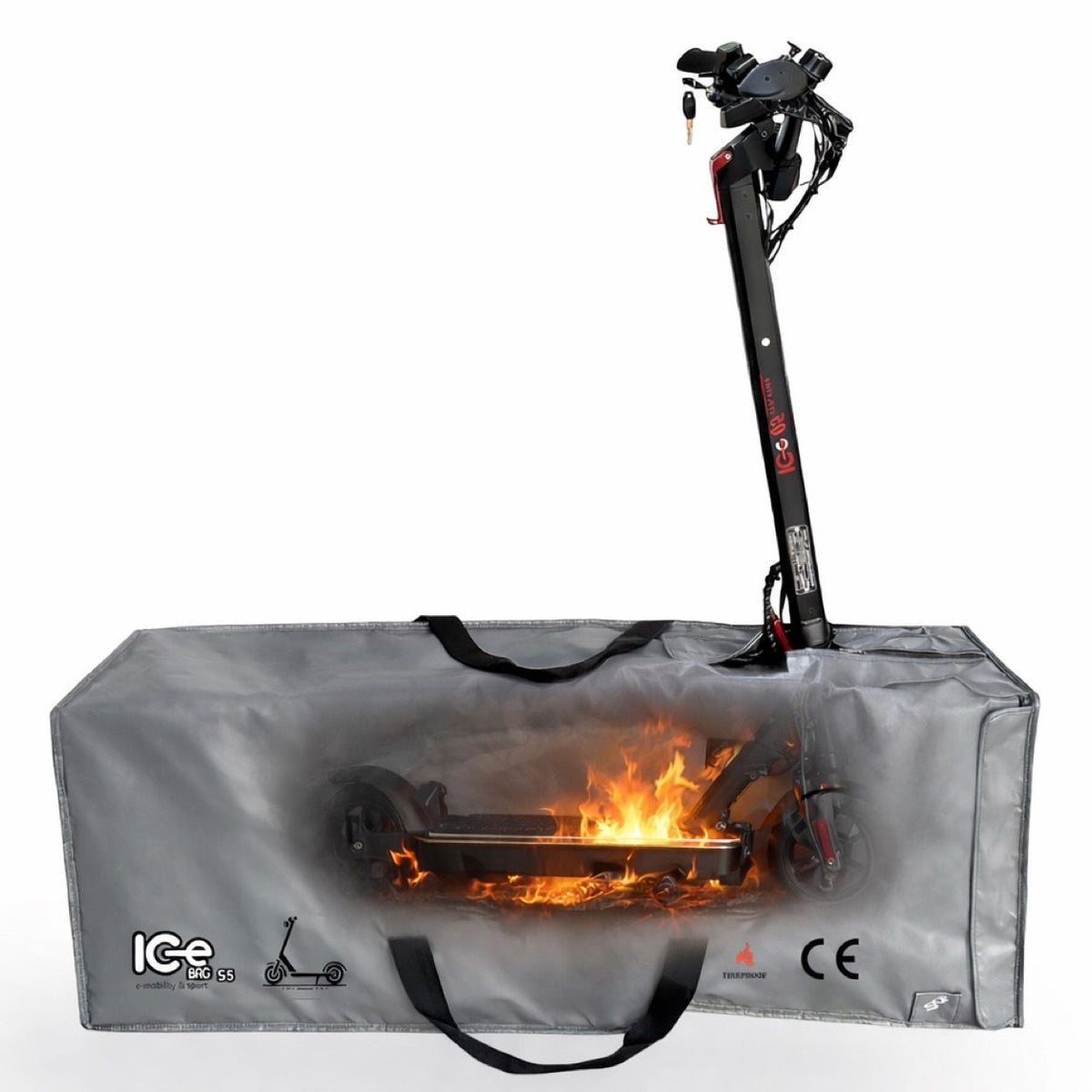
Here is how that reads in practice. The ICe BAG range has been tested by the independent laboratory ATS Electronic Technology, report ATSR240420811, covering models S1 to S5. The test was run against a real thermal runaway, with a complete scooter and its battery inside the closed bag. The result was no flame escape to the outside, no rupture of the enclosure and low smoke emission. That level of detail is what lets you genuinely compare two products.
Alongside the product test, ask for material reports too. The reports for the ICe BAG three layer complex of 1.7 mm, rated UL 94 V-0, and for the outer fabric, rated UL 94 VTM-0, are issued by SGS. If chemical composition matters to you, SGS has also analysed the materials under REACH, RoHS and California Proposition 65.
How to measure your folded scooter
This is the step most people skip, and the one that best guarantees you get the size right. Do it before you look at prices.
1. Fold the scooter exactly as you will store it. Handlebar folded or lowered, mirrors removed or turned inwards, seat detached if you use one. Measure it in the same position it will sit in inside the bag.
2. Length. From the front end to the rear end, counting the mudguard, rear light and any protruding part. Rest the scooter on the floor and measure horizontally.
3. Width. The widest part of the whole, usually the folded handlebar, the grips or the mirrors if you keep them on.
4. Height. From the floor to the highest point with the handlebar already folded, normally the steering column resting on the deck.
Write the three numbers down in centimetres and add 3 to 5 cm of margin to each one. That margin is what lets the closure run smoothly and keeps the fabric relaxed. Measure with the accessories you plan to keep inside as well (charger, lock, handlebar bag), because they take up more room than you expect. And if your measurement falls right between two sizes, the larger size is the comfortable choice.
With your three measurements in hand, the compatibility guide by brand and model tells you directly which size matches your scooter.
Whether it works for charging inside or for storage
Not every bag is designed for the same moment of the day. Some are purely for storage: the scooter goes in and that is it. Others also let you charge with the bag closed, and for that they need one specific detail: a cable pass-through, meaning an opening prepared for the charger cable while the closure stays done up.
If you charge at home, on a landing or in a storage room, this is probably the feature you will use most. The whole ICe BAG range, from S1 to S5, includes a cable pass-through, so the charging cycle happens with the scooter already inside and the bag closed.
As good practice, it is worth charging in a clear area, with a smoke alarm nearby and, whenever you can, at a time when you are at home.
What it should be proven to contain, not just to resist
Resisting and containing are two different things, and many product sheets blur them. A resistant material withstands heat for a period of time. A containment product keeps the event inside the closed enclosure and controls what happens outside it.
When you compare, look for a test that describes a full event happening inside the closed bag, and that reports three things measured on the outside: whether flames escaped, whether the enclosure stayed intact and how much smoke was emitted. Material ratings such as UL 94 V-0 and UL 94 VTM-0 describe how the fabric behaves in the presence of flame; the containment test describes the finished product. The two add up, and having both is ideal.
Construction and closure
These are the details you notice when you handle the product, and they should be on the spec sheet too:
- Number of layers and stated thickness. A concrete figure, such as the ICe BAG three layer complex of 1.7 mm, is more useful than the word multilayer.
- Overlapping closure. A fabric flap covering the zip is what keeps the closure line at the same standard as the rest of the bag.
- Seams and technical thread, especially at handles and corners, where the load concentrates when you lift the whole thing.
- Handles and base reinforcement, because a scooter has weight and the bag rests on the floor every day.
- In-house design. Signals such as the two registered patents behind ICe BAG point to genuine development rather than a rebadged generic cover.
Common mistakes when choosing a size
- Measuring the scooter unfolded and comparing that number with sizes meant for the folded scooter.
- Measuring without the accessories that will later go inside.
- Going by the model name alone. The same model can have versions with different dimensions depending on the year.
- Choosing the tightest size so it looks compact, when day to day it is far more comfortable if the scooter slides in and out easily.
- Forgetting where the bag will live. If it goes in the boot, measure the boot as well.
- Deciding the size before the format. Some bags are made for the fully folded scooter and others for carrying it unfolded with the handlebar outside, and those are two different formats.
That last decision, storage format or transport format, is what organises the whole choice. We have set it out model by model in the guide to the ICe BAG range, with all five formats and the use each one answers.
The short version
Ask for the independent laboratory report and read it against the five details in the first section. Measure your folded scooter and add margin. Decide whether you want to charge inside. Check that the test talks about containment and not only resistance. And pick the format that fits your routine. With those five points you can compare any bag on the market on your own terms.

Written by Oscar Creix