House Rules, German WEG Law and Battery Fire Safety: What E-Scooter Owners in Apartment Buildings Really Need to Know
In Germany's cities, more and more people commute to work, the station or simply around the daily traffic jam on an e-scooter. But many owners only discover the other side of the coin when the building manager rings the doorbell or a new notice goes up in the hallway: where exactly is this vehicle allowed to stand in an apartment building? And where can the battery be charged without running into trouble with the house rules, the homeowners' association, or, in the worst case, the building insurance?
The answer is more uncomfortable than most people expect: in Germany there is not a single federal law that clearly regulates where an e-scooter battery may be stored and charged inside a flat. The legal landscape is fragmented and depends on several layers: whether you rent or own, what the building's house rules (Hausordnung) may actually require, what the homeowners' association (Wohnungseigentümergemeinschaft, WEG) has decided and, not least, whether the building insurance will cover a loss if something goes wrong.
This guide brings order to the subject. It explains the legal framework, the role of the Hausordnung and the German WEG, the most common insurance pitfalls and three practical paths to operate your e-scooter in a rented flat or owned apartment safely and within the law.
The legal starting point: a patchwork, not a clear rule
Anyone searching online for a definitive rule quickly runs into a sobering reality: at present, Germany has neither a firm regulatory framework nor binding public-law provisions that govern the storage and charging of lithium-ion batteries inside residential flats. The only reference points are:
- The building codes (Landesbauordnungen) of the respective federal states and the corresponding garage ordinances. Fire protection in Germany is the responsibility of the Länder.
- The German Condominium Act (Wohnungseigentumsgesetz, WEG) and tenancy law in the German Civil Code (BGB), which regulate the relationship between owners, tenants and managers, but do not specifically address batteries.
- Recommendations such as the guidance issued by the Gesamtverband der Deutschen Versicherungswirtschaft (GDV, the German Insurance Association) on lithium-ion battery storage. These are explicitly not laws but loss-prevention recommendations, though insurers routinely use them as a benchmark in claims handling.
- Individual court rulings that have only brought partial clarity.
Most conflicts arise from this very gap. Landlords, building managers and homeowners' associations fall back on the Hausordnung to enforce a rule that federal law does not actually set. And tenants and apartment owners are often uncertain how far those internal rules can really go.
E-scooter is not the same as e-bike: why the distinction changes everything
Before answering the question "may I store my e-scooter in my flat?", you need to understand that German law treats e-scooters and e-bikes very differently.
E-bikes (pedelecs up to 25 km/h) are legally bicycles. They may, in principle, be stored in a bicycle cellar. A Hausordnung generally cannot ban taking them through the stairwell or into the flat, as long as no damage to the common property and no blocking of escape routes occur.
Road-legal e-scooters, by contrast, are motor vehicles under the German Small Electric Vehicles Regulation (eKFV). They require an insurance plate (the so-called Mopedkennzeichen) and are therefore subject to the same legal framework as other licensed vehicles. A landlord or a homeowners' association is not, in principle, obliged to tolerate a motor vehicle being brought into the building, let alone charged inside.
This legal distinction has a key consequence: as soon as the battery of an e-scooter is removed from the vehicle, it legally ceases to be part of the vehicle and is treated as a standalone component. For models with removable batteries, this opens a very practical legal back door that we will return to below.
What a Hausordnung can actually prohibit
The Hausordnung forms part of the rental agreement and is binding on all residents. But it cannot regulate everything. It must operate within the existing legal framework. For e-scooters and batteries, the following points are decisive:
Stairwell: almost always prohibited
This is the clearest case. In apartment buildings, stairwells are escape routes. The state building codes require these routes to remain free and usable in a fire. Even an ordinary bicycle in the stairwell can become a tripping hazard for fleeing residents or for firefighters. With an e-scooter and its lithium-ion battery as an additional fire risk, the prohibition is even clearer. A Hausordnung that bans parking in the stairwell is therefore almost always legally sound.
Common cellar: usually restricted, often prohibited
Here things get more nuanced. Storing an e-scooter in your own, lockable cellar compartment is often legally possible as long as the Hausordnung does not explicitly forbid it. Charging in the cellar is another matter. Several conditions need to be met:
- The charging current may not come from the building's common-area electricity supply. That would be drawing power at the expense of the other residents and is not permitted.
- The charging process should ideally be supervised. That is practically impossible in a cellar and is one of the main reasons insurers view it critically.
- Fire protection requirements under the applicable state building code must be observed.
Many Hausordnungen therefore prohibit charging in the common cellar outright. Such clauses are generally enforceable because they rest on legitimate fire-protection interests.
Bicycle cellar: a grey zone
Some Hausordnungen allow bicycles and e-bikes in the bicycle cellar but explicitly exclude e-scooters because they are motor vehicles. This differentiation is legally defensible but not always sustainable, as it depends on the specific reasoning and individual case.
Inside the flat: usually permitted, but with strings
Inside your own flat, the tenant's right to contractual use of the rented property applies. A blanket ban on charging an e-bike or e-scooter battery inside a flat is, in most cases, not enforceable. The situation changes when the rental agreement or Hausordnung contains concrete, fire-protection-related conditions, for example, that charging may only take place under supervision, or that no vehicles requiring insurance plates may be brought into the flat.
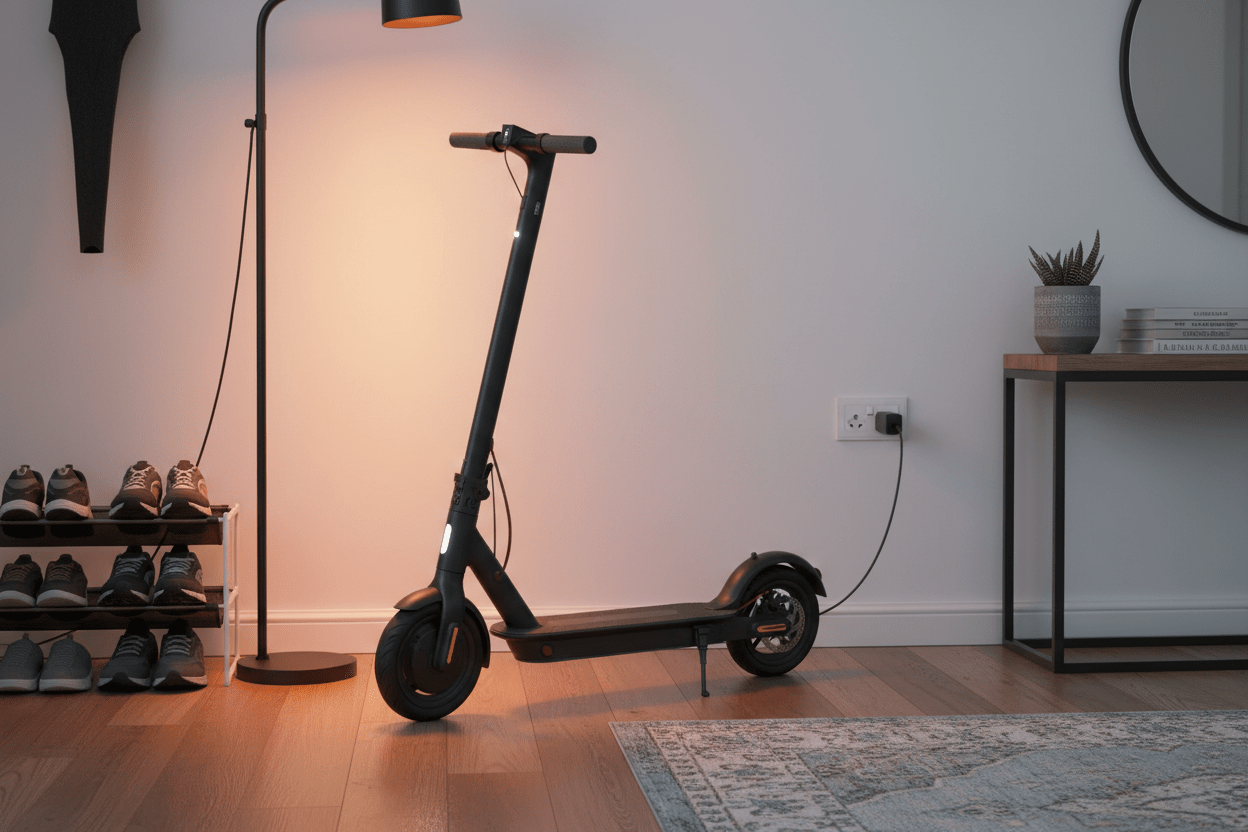
In practice, the following model has become widely accepted in rental relationships: the vehicle stays in the cellar or garage. The removable battery is brought into the flat and charged there under supervision inside a fireproof bag. This solves several legal and practical problems at once, and it is precisely why this solution has prevailed.
Owned apartments and the WEG: who decides here?
In an owned apartment, different rules apply. There is no single landlord but a homeowners' association governed by the German Condominium Act (Wohnungseigentumsgesetz, WEG). The 2020 WEG reform changed quite a bit, particularly regarding fire protection and how the community takes decisions.
What the homeowners' association may decide
The association may, by majority vote, adopt rules on the use of common property, covering cellars, garages and stairwells. Such resolutions may restrict or exclude the storage and charging of e-scooters in common areas.
However, these resolutions must comply with applicable law. The German Federal Court of Justice (Bundesgerichtshof, BGH) made it clear in its ruling of 28 January 2022 (case ref. V ZR 106/21) that an owners' meeting cannot pass resolutions that violate building law. A resolution allowing parking in a fire-engine access route, for example, would be void.
Conversely, there are decisions showing that the association cannot prohibit everything either. The Wiesbaden Local Court (Amtsgericht) on 4 February 2022 (case ref. 92 C 2541/21) prohibited a homeowners' association from banning the parking of electric cars in the building's own garage. The reasoning is transferable to e-scooters: a blanket prohibition without concrete fire-safety justification will struggle to hold up.
What owners and tenants in a WEG should concretely do
- Review the resolutions. Anyone living in an owned apartment should read the minutes of the last few owners' meetings. What has the association resolved regarding batteries, e-mobility or fire safety?
- Take the initiative. If no rule exists, it is wise to actively propose a resolution offering a reasonable solution that protects all parties. That is almost always better than waiting for a more restrictive resolution pushed through by neighbours after an incident.
- Rely on expertise. Following the WEG reform, fire safety in homeowners' associations is more closely tied to the management. Property managers can, even without a resolution, take measures under section 27(1)(1) WEG if it concerns the proper preservation of common property. This route can be used to drive constructive solutions.
The insurance trap: the overlooked risk
Even if the Hausordnung says nothing and the homeowners' association has resolved nothing, there is one actor who can become a problem after a fire: the insurer.
Building insurance: increased risk
Building insurance generally covers fire damage to the property. But insurers can argue that charging an e-scooter battery in the flat or cellar constitutes an "increase of risk" (Gefahrerhöhung), particularly if charging is done unsupervised or near combustible materials. The consequence: in the event of a claim, the payout may be reduced.
For slightly negligent handling, most building insurers will pay. For gross negligence (for example, unsupervised overnight charging close to curtains or a clothes dryer), things change. Some insurers expressly waive any reduction in such cases, but many do not. Anyone wanting full certainty should ask their insurer in writing how they assess charging an e-scooter battery in a rented or owned apartment.
Contents insurance: the same logic
The same principle applies to household contents (furniture, electronics, clothing). Contents insurance can pay out after a battery fire, but it scrutinises whether gross negligence was involved. A known-damaged battery that was still being charged is the textbook case where the insurer reduces or refuses payment.
Motor third-party liability: only part of the solution
Because e-scooters are motor vehicles, they must carry motor third-party liability insurance (which is why they need the Mopedkennzeichen). This liability cover responds to damage the vehicle causes to third-party property, including building damage. But: it pays only the current value, not the replacement value. The building insurance, by contrast, replaces at new-for-old. A landlord does not have to accept that residual risk, and this is one of the reasons some landlords are more restrictive than the law alone would require.
What this means in practice
Insurers are not public authorities and cannot prohibit anything. But they can push back hard after a claim. Anyone running an e-scooter in an apartment building should:
- Actively review insurance cover, both contents insurance and, if you are an owner, building insurance.
- Request written guidance from the insurer on how the battery must be charged for cover to remain effective.
- Know and follow the GDV recommendations, which will be used as a yardstick for duty-of-care in a claim.
When it burns: what really happens
Statistically, the fire probability of a single lithium-ion battery is low. Across millions of e-bikes and e-scooters in use, the risk is in the per-mille range. But when it happens, the consequences are often severe.
Lithium-ion batteries are not a single cell. They are packs of many cells interconnected. When one cell goes into so-called thermal runaway, it can ignite the neighbouring cells in a self-amplifying chain reaction. In a fully developed battery fire, temperatures exceed 1,000 °C, the released gases are highly toxic, and the fire can re-ignite repeatedly even after the visible flames appear extinguished. Water alone does not reliably extinguish such a fire. On the contrary, it can cause explosive flare-ups.
The German Institute for Loss Prevention (Institut für Schadenverhütung, IFS) has found that three out of four battery fires occur during charging, not while riding, not during static storage, but specifically when the battery is plugged in. In the United Kingdom, fires caused by e-bikes rose to 362 incidents in 2024, more than double two years earlier. Comparable consolidated figures for Germany are not yet available, but insurers and fire services consistently report an increase.
A real case from Mönchengladbach illustrates this: an older tenant of an apartment in a multi-family building plugged his electric wheelchair into the common-area mains in the cellar of the building. The vehicle overheated, presumably due to overcharging, and caught fire. The smoke gases reached residents on the eighth floor and caused injuries. Smoke and soot spread through the entire stairwell. Incidents like this explain why building insurers and property managers have become noticeably more sensitive to lithium-ion batteries over recent years.
THE CONTAINMENT LAYER
If your building or your insurer asks for a concrete measure
The ICe BAG is a fireproof bag tested in an independent laboratory against a real thermal runaway: a complete scooter, with its lithium battery, inside the closed bag. Result: no flame escaping to the outside, no rupture of the enclosure and low smoke emission. The report (ATS Electronic Technology, ATSR240420811) is available on request, and it is usually the exact document a building manager or an insurer asks to see.
Three legal paths to operate your e-scooter safely
The intersection of legal, insurance and fire-safety considerations produces three legitimate paths in practice.
Path 1: charge the battery separately inside the flat, the most common solution
If your e-scooter has a removable battery, this is the cleanest option in most apartment buildings:
- The scooter itself stays in the cellar, the underground garage or a suitable outdoor parking area.
- The battery is removed and brought up into the flat.
- The battery is charged under supervision inside a fireproof bag or box with a clearly identifiable fire-containment function.
- A functional smoke detector in the same room ensures early detection.
This path solves several issues at once: the scooter as a vehicle does not enter the flat (legally, the removed battery is no longer part of the vehicle). Charging is supervised. The thermal load is contained by the fireproof enclosure. In the very rare event of thermal runaway, what escapes the bag is not open flames but controlled smoke, and a household smoke detector compliant with EN 14604 is designed to detect exactly that.
Path 2: own garage or parking space with fire safety
If you have your own separate space in an underground garage or your own garage, you can charge there. Conditions:
- Your own power supply (no common-area electricity).
- Compliance with the fire-safety requirements of the applicable state garage ordinance.
- Charging not done overnight or unsupervised wherever possible.
- A fireproof enclosure around the battery or the whole vehicle markedly reduces the thermal load.
- A smoke detector in the parking space (ideally linked to the flat) is a sensible addition.
Path 3: a community solution with the WEG or the landlord
In modern residential complexes with many e-bike and e-scooter users, a shared solution is often the best path. This can take the form of a dedicated fire-resistant room used exclusively for battery charging, equipped with smoke detection and fireproof containers. Such rooms can be established by majority resolution of the owners' meeting or by agreement with the landlord. The GDV recommendations provide a good benchmark here: when storing several medium-power batteries (e-bikes, e-scooters) with a combined gross weight of more than 12 kg, the stricter requirements applicable to high-power batteries should be observed.
What you can do right now
So you are not caught off-guard at the next residents' meeting, here is a five-step checklist:
- Check the Hausordnung and your rental contract. Does it say anything about e-scooters, electric vehicles, batteries or fire safety? If so: how strictly is the clause worded?
- If you own: read the WEG meeting minutes from the past three years. Are there resolutions on e-mobility or fire safety? If not, it is worth raising the issue proactively.
- Inform your insurer in writing. A short query to your contents and building insurer creates legal certainty. In the best case you receive a written confirmation that coverage remains intact for the charging of an e-scooter battery.
- Always charge the battery inside a fireproof bag. This is the only measure that works mechanically and not just legally. A suitable enclosure limits the thermal load and prevents a battery fire from turning into a flat fire.
- Install a smoke detector near the charging point. Functional, compliant with EN 14604, in the same room. With a battery fire contained inside a bag, smoke is the primary signal, not open flames or heat. That is precisely what a standard smoke detector is built for.
Frequently asked questions
Can my landlord ban me from keeping my e-scooter inside my flat? A blanket ban is generally not enforceable, provided the vehicle does not damage the property and no fire-safety rules are violated. The situation is different when the Hausordnung contains specific, properly justified conditions, for example, on unsupervised charging.
May I charge the battery in the common cellar? In most cases, no. Charging in the shared cellar typically violates the Hausordnung, may involve drawing on common-area electricity, and is viewed very critically by insurers. The better option is to remove the battery and charge it under supervision inside your own flat.
What happens if I violate the Hausordnung? On the first occasion, normally a formal warning (Abmahnung). On repeated violations of contractual duties, this can lead to ordinary termination of the rental agreement. In owned apartments, the homeowners' association can pursue injunctive remedies.
Will my insurance pay if my battery causes a flat fire? In principle yes, provided there is no gross negligence. Risk factors are: unsupervised overnight charging, charging a damaged or dropped battery, using a non-original charger, and charging near combustible materials. Where gross negligence is present, many insurers reduce or refuse the payout.
Is a normal smoke detector enough for a battery fire? If the battery is charged inside a fireproof bag, yes. The bag contains the flames and heat but lets smoke escape, and smoke is exactly what a standard smoke detector compliant with EN 14604 detects. Without a bag, the situation is less predictable, because open flames and high temperatures quickly engulf the surroundings.
What does the German Federal Court of Justice say on this? At the highest court level, the question of whether e-scooters may be charged inside flats has not yet been conclusively settled in Germany. There are individual lower-court rulings such as the Wiesbaden Local Court decision of 4 February 2022 (case ref. 92 C 2541/21), which views blanket bans on electric cars in garages critically. The reasoning can be extended to e-scooters but does not amount to binding precedent in the strict sense.
What role do the GDV recommendations play? The German Insurance Association's recommendations are not laws, but insurers use them as a yardstick for duty-of-care. Anyone who follows the GDV guidance is markedly better positioned if a claim arises.
Bottom line: clear rules don't exist, clear responsibility does
In 2026, Germany's legal landscape on e-scooters in apartment buildings is still a patchwork of tenancy law, the WEG, state building codes, insurance terms and selective court rulings. Anyone waiting for definitive Federal Court of Justice clarification is likely to be waiting for a long time.
What tenants and owners can already do is straightforward and effective: know the Hausordnung, talk to the landlord or the WEG, clarify the insurance position, and in everyday use choose a setup that mechanically limits the fire risk. A fireproof bag for the battery, a smoke detector nearby and supervised charging are no guarantee that nothing will ever happen. But they are the only practical answer to the fact that lithium-ion batteries carry a residual risk, and they create exactly the level of due care that, in a claim, makes the difference between full payout and a reduced one.
For e-scooter owners in apartment buildings, the rule is this: those who are informed get to choose. Those who are not let others (landlords, property managers, insurers) choose for them. And that rarely ends in their favour.
Related resources on our blog
- Fire safety solutions for electric scooters at home: a complete guide
- Where is the safest place to store your electric scooter at home?
Note: proven safety for e-scooter batteries
ICe BAG develops and produces fireproof bags and containment garages for lithium-ion batteries of e-scooters and e-bikes. Our products are specifically designed for residential use in apartments and multi-family buildings.

Written by Oscar Creix